
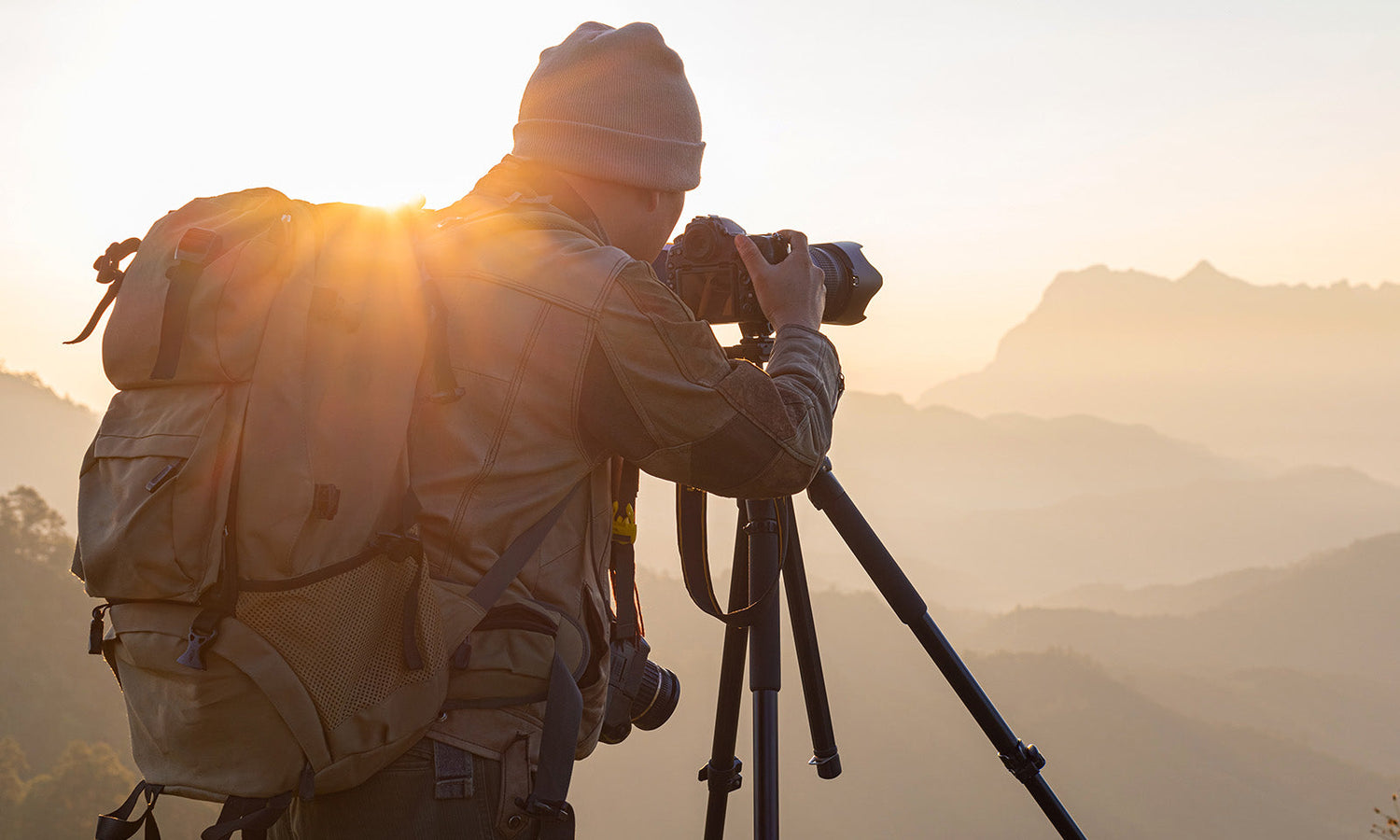
Landscape photography doesn't always happen somewhere easy.
It happens on top of wet hillsides at 5am, on craggy coastal cliffs, in boggy fields, and at remote viewpoints where the best light often appears for only a few minutes. The locations that make the most compelling photographs are often the same ones that are hardest on both you and your gear. That is where traditional camera carrying systems begin to show their limits.
The Problem with Traditional Camera Carrying

A neck strap might feel fine on a short walk or in a controlled environment, but on rough terrain it quickly becomes something you have to manage. The camera swings as you move, pulls forward on your neck and shoulders, and can become a distraction when you need to focus on your footing.
A shoulder bag has its own drawbacks. It may carry weight reasonably well on flat ground, but once you are climbing, crossing uneven terrain or moving through mud, it can shift your balance and make every step feel harder. The more demanding the location, the more noticeable those compromises become.
When Gear Gets in the Way
There is a particular frustration that comes with location shooting. You have driven an hour, hiked another, checked the forecast, timed your arrival and waited for the right conditions. Everything depends on a narrow window. The last thing you need is a carrying system that gets in the way:
- A strap that slips
- A bag that needs to be taken off, opened and rifled through
- A camera that is either buried away or swinging loose while you move
In the field, small inconveniences become bigger problems because they cost energy, attention and time. They can also cost the shot.
The Light Does Not Wait
 Landscape photography is full of short windows.
It might be a break in the clouds, mist lifting from a lake, or a sky just before the sun sets. These moments can last minutes.
If your camera is packed away, that delay matters. Stopping, opening a bag, retrieving the camera and getting ready to shoot can be the difference between capturing the scene and watching it disappear. That is why access matters. The camera needs to be secure while you move, but ready the moment conditions change.
The Physical Toll Adds Up
Long days in the field are in the job description. Many landscape photographers are out before dawn, walking across difficult ground and staying until the last of the light has gone.
Over time, carrying a camera on the neck or one shoulder can become a source of steady discomfort.
- Weight pulling forward on the neck
- Strain through the shoulders
- Imbalance across the upper back
- General fatigue
All make the second half of a shoot harder than it needs to be. At that point, the problem is no longer just the gear. Your body is becoming a limiting factor in your shoot.
A Better Way to Carry

The most effective solution is to move the weight away from the neck and shoulders and down to the hips, where the body is better equipped to carry the load. That is the principle behind a belt-mounted camera carrying system.
With the camera held securely at hip height, it stays close to the body, out of the way while you move and ready to draw when the light changes. There is no swinging camera to manage, no bag to open and no constant pressure through the neck and shoulders. For landscape photographers, that means more freedom on the move, less fatigue across long days and faster access when conditions finally come together.
Built for the Way Landscape Photographers Actually Work

The best landscape images can come from going further, staying longer and working in conditions that are less than comfortable. Your carrying system should support that, not fight against you. A hip-mounted holster gives photographers a way to keep their camera secure, accessible and comfortable throughout the day, whether they are climbing to a viewpoint, crossing uneven ground or waiting for the light to do something extra special.
When the moment arrives, your camera will be right where it needs to be.


Leave a comment
All comments are moderated before being published.
This site is protected by hCaptcha and the hCaptcha Privacy Policy and Terms of Service apply.